
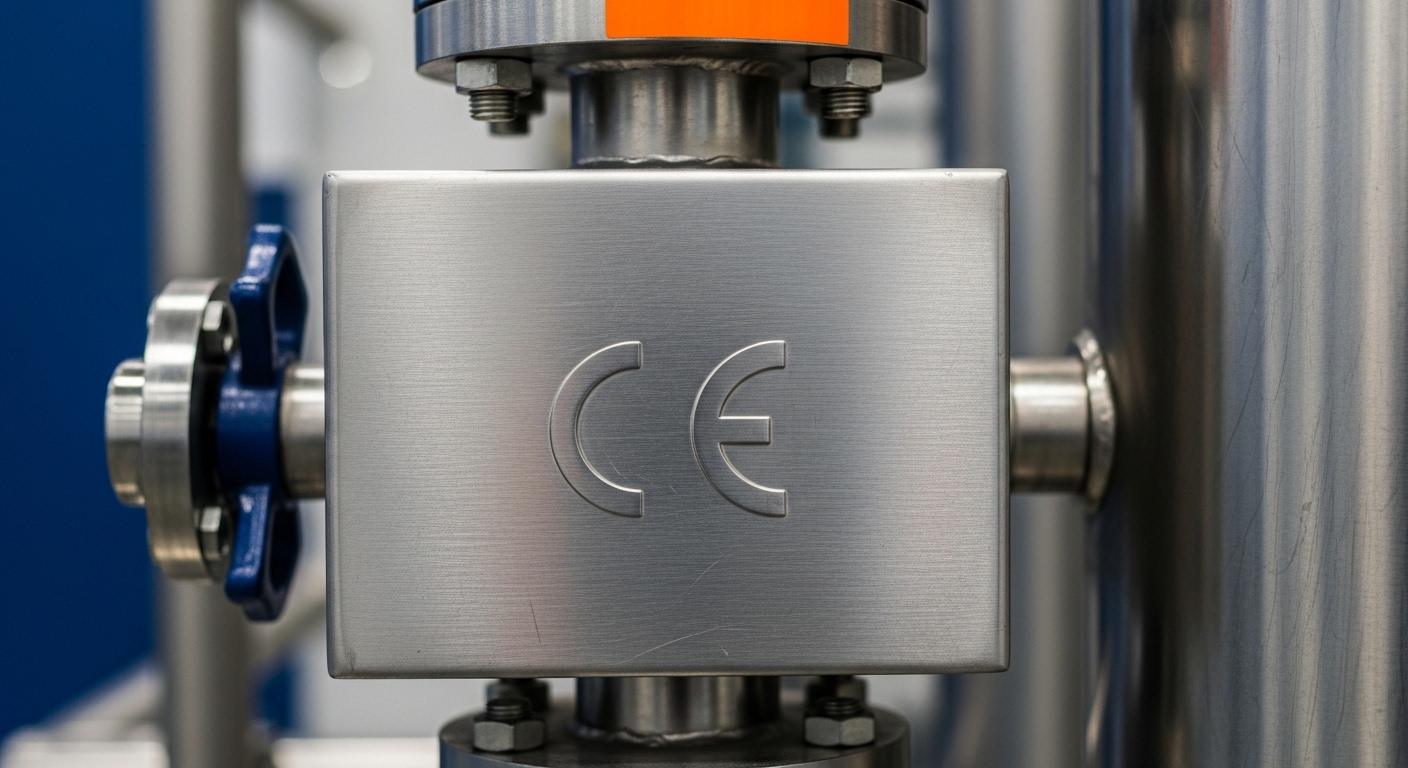
CE marking is a manufacturer's self-declaration that a product complies with EU health, safety, and environmental requirements. For 97% of CE-marked products, no third party verifies the declaration — the manufacturer signs a Declaration of Conformity and stamps the mark themselves. For MENA importers, this means a CE mark without a technical file is worthless, and the infamous "China Export" fake CE looks almost identical to the real one. Here is how to tell them apart and why it matters for your shipments.
What CE marking actually is (and isn't)
CE stands for Conformité Européenne — "European Conformity." It is required for 26 product categories sold in the European Economic Area, including:
- Machinery (Machinery Directive 2006/42/EC)
- Low-voltage electrical equipment
- Toys (2009/48/EC)
- Medical devices
- Pressure equipment
- Radio equipment
- Personal protective equipment
- Construction products
What CE is NOT:
- Not a quality mark (it does not certify performance)
- Not a product of EU origin (Chinese products can legally carry CE if compliant)
- Not verified by a third party in most cases (self-declaration)
- Not relevant outside Europe (it is a EU-specific compliance marker)
Why MENA regulators still care about CE
Despite being an EU regulatory tool, CE carries real weight in MENA procurement:
- Saudi Arabia SABER platform accepts CE as supporting evidence for Product Certificate of Conformity applications in many categories
- UAE ECAS certification scheme directly cross-references CE compliance for low-voltage, machinery, and medical device categories
- Egypt GOEIC inspections give faster clearance to CE-marked goods in industrial categories
- Gulf government tenders often require CE marking as a prerequisite for bids in industrial equipment, medical devices, and construction materials
The practical effect: CE marking reduces your MENA customs clearance time by 3-7 days compared to non-CE equivalents, and opens doors to regulated procurement markets.
The fake CE problem — "China Export" vs real CE
There is a widely documented phenomenon where Chinese manufacturers apply a mark that looks almost identical to the EU CE mark but is actually a Chinese "China Export" stamp. Visually:
- Real CE: The C and E letters are circles, with the gap between them approximately the same as the width of the E's middle horizontal bar
- Fake CE ("China Export"): The letters are tighter together, often with the gap between C and E being narrower than a single line width
The distinction is subtle but consistent once you know what to look for. Most MENA customs officers do NOT visually inspect CE marks — they rely on the Declaration of Conformity document.
Practical rule: If you cannot get a Declaration of Conformity (DoC) from the supplier, the CE mark is worthless regardless of how it looks. If you can get a DoC, the visual mark doesn't matter because regulators will read the document.
What a real CE file looks like
For any CE-marked product sold into the EU, the manufacturer must have:
1. Technical File
Kept for 10 years after the last unit is sold. Contains:
- General description of the product
- Design and manufacturing drawings
- Descriptions of applied harmonized standards
- Test reports
- Risk assessment
- Quality management documentation
2. Declaration of Conformity (DoC)
A one-page formal statement signed by the manufacturer, including:
- Product name, model, serial or lot numbers
- Applicable EU directives (e.g. 2006/42/EC for machinery)
- Applied harmonized standards (e.g. EN ISO 12100:2010)
- Name and signature of the responsible person
- Place and date of issue
3. Notified Body involvement (only for some categories)
For high-risk categories (medical devices Class IIa+, pressure equipment above certain thresholds, elevators), a Notified Body must audit the manufacturer. The Notified Body's 4-digit number appears next to the CE mark.
If you see CE-[4-digit number], there is third-party verification. If you see just CE, it is manufacturer self-declared.
How to verify a CE mark before buying
Before issuing a PO for CE-marked goods, ask the supplier for:
- Copy of the Declaration of Conformity — PDF or scan, signed and dated within the last 2 years
- List of harmonized standards applied — should match the product category
- Notified Body certificate (if the product category requires one) — verify the NB number at `ec.europa.eu/growth/tools-databases/nando`
- Technical file summary — not the full file (confidential), but an index showing it exists
- Request the DoC from the supplier before presenting them to you
- Verify the applied harmonized standards against your product category
- Cross-check Notified Body numbers (when applicable) in the NANDO database
- Include the DoC in the shipment's document package so customs clears the first time
If the supplier cannot provide these within 48 hours, the CE mark is likely cosmetic. Walk away from the deal.
Common compliance mistakes that cost MENA importers money
1. Buying "CE-marked" goods without a DoC
The goods arrive, SABER or ECAS asks for the DoC, the supplier cannot produce it, container sits at port.
Cost: 200-400 USD/day demurrage + potential rejection and return freight. A 30,000 EUR shipment can lose 3,000-8,000 EUR in a single week.
2. Accepting a generic "CE" certificate instead of the DoC
Some suppliers issue a one-page internal "CE certificate" that is not the legally required DoC. Regulators can reject it.
Prevention: Specifically request "Declaration of Conformity" in writing, not just "CE certificate."
3. Ignoring category-specific requirements
A machinery product needs DoC + technical file + possibly notified body. A toy product needs DoC + EN 71 test reports. A medical device Class IIa+ needs DoC + notified body audit + clinical evaluation report. Each category has different requirements.
Prevention: Identify the exact applicable EU directive before buying. "Machinery Directive" and "Toy Directive" are not interchangeable.
4. Assuming a Chinese supplier's CE is valid for EU re-export
Some MENA importers buy CE-marked Chinese goods to re-export into European free zones. EU customs can challenge the CE mark if the manufacturer has never been registered with an EU Authorised Representative.
Prevention: For re-export into the EU, verify the supplier has an EU-based Authorised Representative.
What Go MENA does for CE-critical imports
For any product where CE marking matters to your destination country's clearance, we:
If a supplier we are considering cannot produce a valid DoC within 2 business days, they get flagged as "prospect" and do not make it to the verified pool.
Request a supplier — we'll confirm CE compliance as part of the standard 9-point verification.